What is Points for Grumpy?
According to Intervention Central, Points for Grumpy is a response-cost strategy that is appropriate for younger students who are verbally defiant and non-compliant with the teacher. This strategy can be altered to use with older students as well.
Materials Needed:
Two coffee cans with lids, point tokens (poker chips, pennies, etc.), student chart (see visual representations)
Preparation:
Take two coffee cans with plastic lids and cut a slot into the lids of both coffee cans. Decorate one can with the name of the target student. The student can decorate his or her coffee can to personalize it. Label the second coffee can "Grumpy." This can be decorated using pictures of frowning faces.
Steps in Implementing Points for Grumpy:
1. Create a menu of rewards for the student. For each reward, decide how many good behavior points the student must earn to get the reward.
2. Tell the student he or she can earn points for politely following adult requests and introduce the "Points for Grumpy Program."
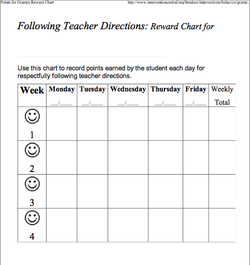
4. Start the program. Use the Student Chart for Points for Grumpy (see visual representations) to record good behavior points the student earns each day.
Materials Needed:
Two coffee cans with lids, point tokens (poker chips, pennies, etc.), student chart (see visual representations)
Preparation:
Take two coffee cans with plastic lids and cut a slot into the lids of both coffee cans. Decorate one can with the name of the target student. The student can decorate his or her coffee can to personalize it. Label the second coffee can "Grumpy." This can be decorated using pictures of frowning faces.
Steps in Implementing Points for Grumpy:
1. Create a menu of rewards for the student. For each reward, decide how many good behavior points the student must earn to get the reward.
2. Tell the student he or she can earn points for politely following adult requests and introduce the "Points for Grumpy Program."
- At the start of each monitoring period, you will put 10 "good behavior" tokens (poker chips or pennies) into your pocket.
- Each time you have to approach or address the student because he or she is verbally defiant or non-compliant, you will take one of the "good behavior" points and drop it into "Grumpy's" coffee can.
- At the end of the period, you will give the student any tokens that remain in your pocket and let the student drop these tokens into his or her coffee can. The student will be able to 'cash in' these tokens or points rewards according to the reward system that you have set up.
- Talking back
- Using a disrespectful gesture or facial expression (eye rolling, for example)
- Muttering
- Failing to comply within 60 seconds of a request
4. Start the program. Use the Student Chart for Points for Grumpy (see visual representations) to record good behavior points the student earns each day.
Student Profile
There is a student in my third grade classroom who often refuses to follow given directions. When given a task, this student typically verbally expresses that he is not going to complete his work and also refuses help from teachers, specialists, and classmates. Once this behavior starts this student tends to stay in a slump for the remainder of the period until transitioning into a new activity. When this student is non-compliant and displays negative attitudes, valuable work time is lost which results in incomplete work that later needs to be made up during class or brought home as homework. Points for Grumpy would help encourage this student to display polite behavior. This strategy involves the student physically putting tokens or pennies that represent good behavior points into a can. For this particular student who is often non-compliant and verbally defiant, an effective reward would be extra time on Raz Kids on the computer. By using the student chart to record good behavior points the student earns each day, the student and their parents can visually see and monitor progress.
Visual Representations
|
The picture on the left shows the Student Chart for Points for Grumpy. Teachers can record good behavior points the student earns each day for respectfully following directions. This chart can be shared and discussed with the student, specialist teachers, and the student's family at the end of the day or week to monitor behaviors.
|
Content Area Examples
Points for Grumpy is a versatile strategy that can be used throughout the entire school day in any or all content areas including reading, math, social studies, science, and more. Points for Grumpy can also be used in specialist classes by physical education, media, music, and art teachers. Specialist teachers can record the number of points lost during the period and report back to the classroom teacher and students can add any remaining tokens or pennies to their designated coffee can after returning to class. It is important that teachers discuss and agree upon behavioral expectations for the student and determine specific behaviors that will result in losing a good behavior point for the day.
